
Project
Reducing transfer errors in a banking experience
Reducing transfer errors in a banking experience
Reducing transfer errors in a banking experience
Project Overview
Redesigned the bank transfer experience to reduce user errors and improve overall satisfaction in a complex financial environment.
Scope: End-to-end (research → delivery)
Impact: -27% errors / +18% user satisfaction
Project Overview
Redesigned the bank transfer experience to reduce user errors and improve overall satisfaction in a complex financial environment.
Scope: End-to-end (research → delivery)
Impact: -27% errors / +18% user satisfaction
Problem
Users were struggling to complete transfers correctly due to:
Confusing flows and unclear feedback
High cognitive load during critical steps
Lack of error prevention and recovery mechanisms
This resulted in:
Frequent failed transactions
Increased user frustration
Higher support costs
Problem
Users were struggling to complete transfers correctly due to:
Confusing flows and unclear feedback
High cognitive load during critical steps
Lack of error prevention and recovery mechanisms
This resulted in:
Frequent failed transactions
Increased user frustration
Higher support costs
Research
We started with a deep analysis of the current flow, combining quantitative and qualitative data:
We mapped out drop-off points and common errors during transfers.
We gathered feedback from the customer service team about frequent user questions and confusions.
We observed real user sessions to identify moments of doubt or cognitive overload.
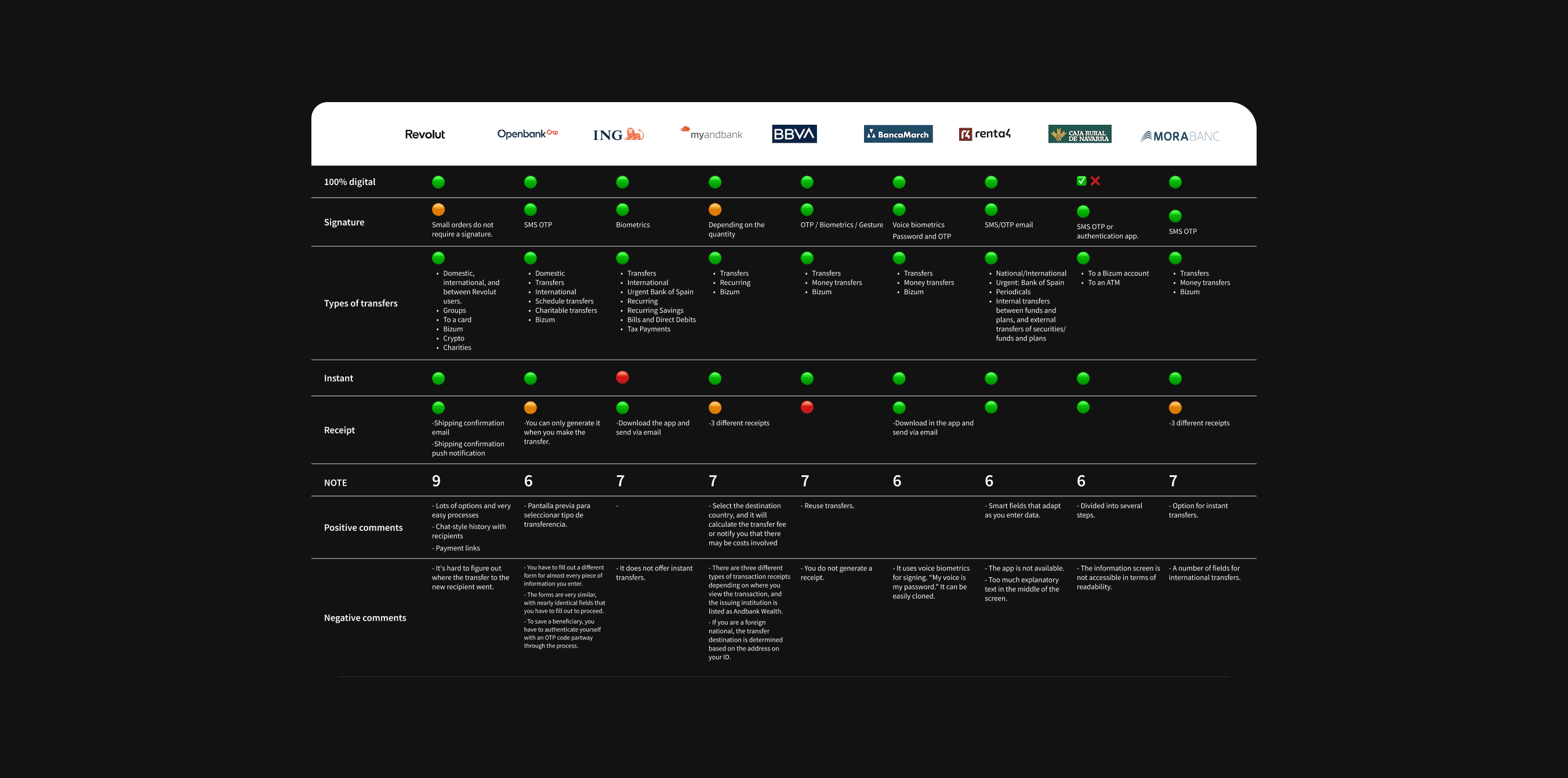
We also conducted a benchmarking of leading banking apps in Europe to understand how they simplified their flows, what steps they removed, and how they communicated sensitive aspects such as IBANs, fees, or security checks.
Research
We started with a deep analysis of the current flow, combining quantitative and qualitative data:
We mapped out drop-off points and common errors during transfers.
We gathered feedback from the customer service team about frequent user questions and confusions.
We observed real user sessions to identify moments of doubt or cognitive overload.
We also conducted a benchmarking of leading banking apps in Europe to understand how they simplified their flows, what steps they removed, and how they communicated sensitive aspects such as IBANs, fees, or security checks.
Design
The redesign was based on three key principles: simplicity, clarity, and guidance. One of the main problems identified was that the entire transfer process was concentrated on a single screen, with many fields and options visible at once. This caused confusion, frequent errors, and an unnecessary feeling of complexity, especially for less experienced users.
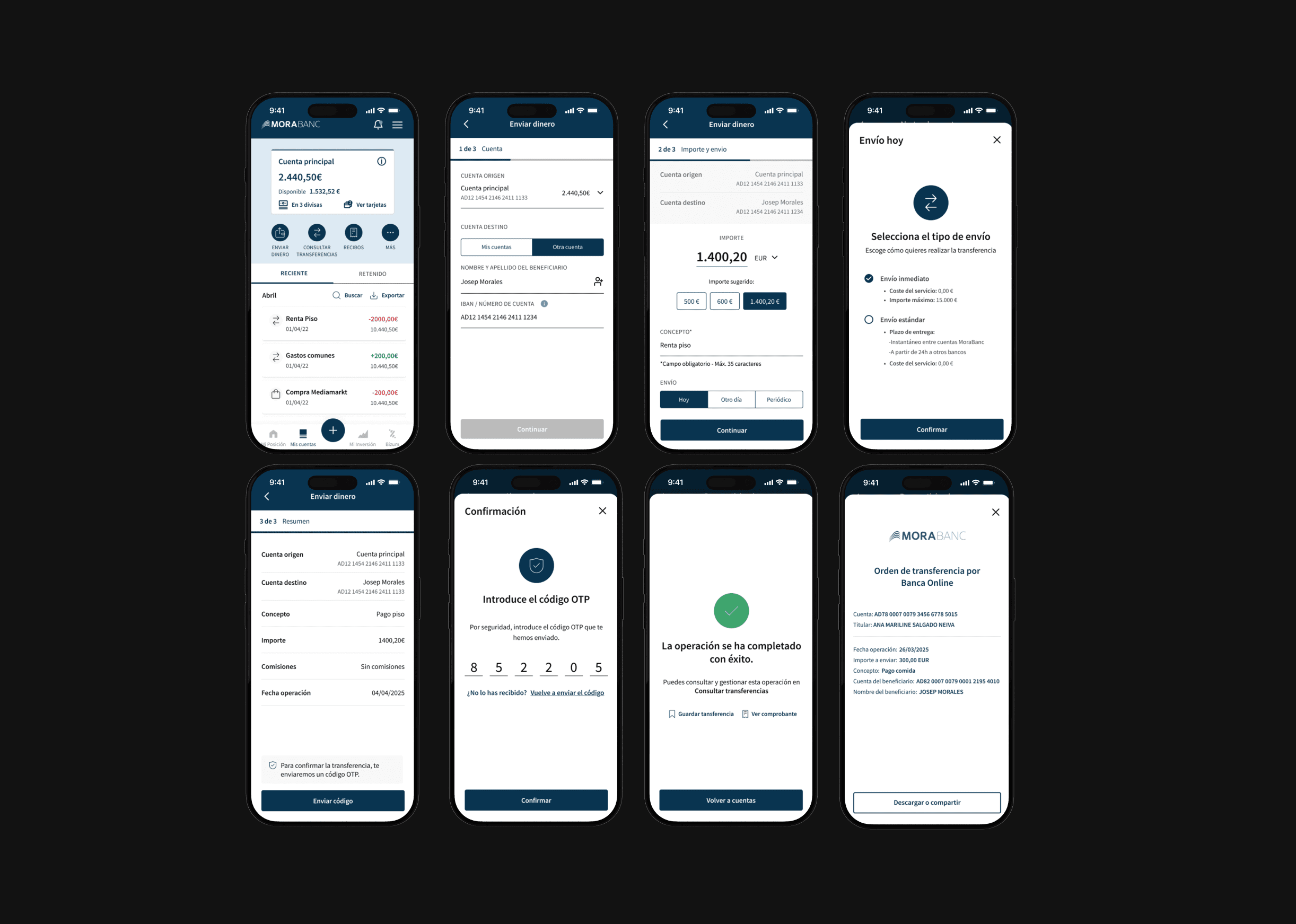
We decided to split the flow into progressive steps, each focused on a single action: account, amount and send, summary. This guided approach reduced cognitive load and allowed users to focus on one decision at a time.
The color of the primary buttons did not meet the minimum contrast standards required for accessibility. Therefore, we updated the color and ran tests to ensure that both people with low vision and those using high-contrast mode could clearly identify the main actions.
We also leveraged available data to speed up the process in repetitive contexts. In step 2, we added suggested amounts based on recent history. This allows users to complete a transfer with a single tap, eliminating the need to retype the same amount repeatedly. In addition, we added the option to repeat a transfer from different parts of the app. This optimized time and reduced friction, especially for those who make frequent transfers to the same accounts.
Design
The redesign was based on three key principles: simplicity, clarity, and guidance. One of the main problems identified was that the entire transfer process was concentrated on a single screen, with many fields and options visible at once. This caused confusion, frequent errors, and an unnecessary feeling of complexity, especially for less experienced users.
We decided to split the flow into progressive steps, each focused on a single action: account, amount and send, summary. This guided approach reduced cognitive load and allowed users to focus on one decision at a time.
The color of the primary buttons did not meet the minimum contrast standards required for accessibility. Therefore, we updated the color and ran tests to ensure that both people with low vision and those using high-contrast mode could clearly identify the main actions.
We also leveraged available data to speed up the process in repetitive contexts. In step 2, we added suggested amounts based on recent history. This allows users to complete a transfer with a single tap, eliminating the need to retype the same amount repeatedly. In addition, we added the option to repeat a transfer from different parts of the app. This optimized time and reduced friction, especially for those who make frequent transfers to the same accounts.
Solution
We approached the redesign by considering a wide range of scenarios (account types, beneficiaries, limits, validations, and potential errors), ensuring that the experience clearly guided users in every case.
To minimize risks in a critical feature, we implemented a multi-phase deployment strategy. First, we conducted an exhaustive internal QA process that helped identify inconsistencies and allowed us to work iteratively with the development team until we achieved a stable version aligned with the design.
Next, we carried out two “Friends & Family” rounds, where employees and collaborators tested the flow in real contexts. This enabled us to validate design decisions, gather qualitative feedback, and refine details before launch.
Thanks to this approach, we were able to detect and resolve issues early, reducing risk and ensuring a controlled, high-quality implementation.
Solution
We approached the redesign by considering a wide range of scenarios (account types, beneficiaries, limits, validations, and potential errors), ensuring that the experience clearly guided users in every case.
To minimize risks in a critical feature, we implemented a multi-phase deployment strategy. First, we conducted an exhaustive internal QA process that helped identify inconsistencies and allowed us to work iteratively with the development team until we achieved a stable version aligned with the design.
Next, we carried out two “Friends & Family” rounds, where employees and collaborators tested the flow in real contexts. This enabled us to validate design decisions, gather qualitative feedback, and refine details before launch.
Thanks to this approach, we were able to detect and resolve issues early, reducing risk and ensuring a controlled, high-quality implementation.
Result
-27% reduction in user errors
+18% increase in user satisfaction
Reduced friction in high-risk financial interactions
Improved overall trust in the product
Result
-27% reduction in user errors
+18% increase in user satisfaction
Reduced friction in high-risk financial interactions
Improved overall trust in the product